

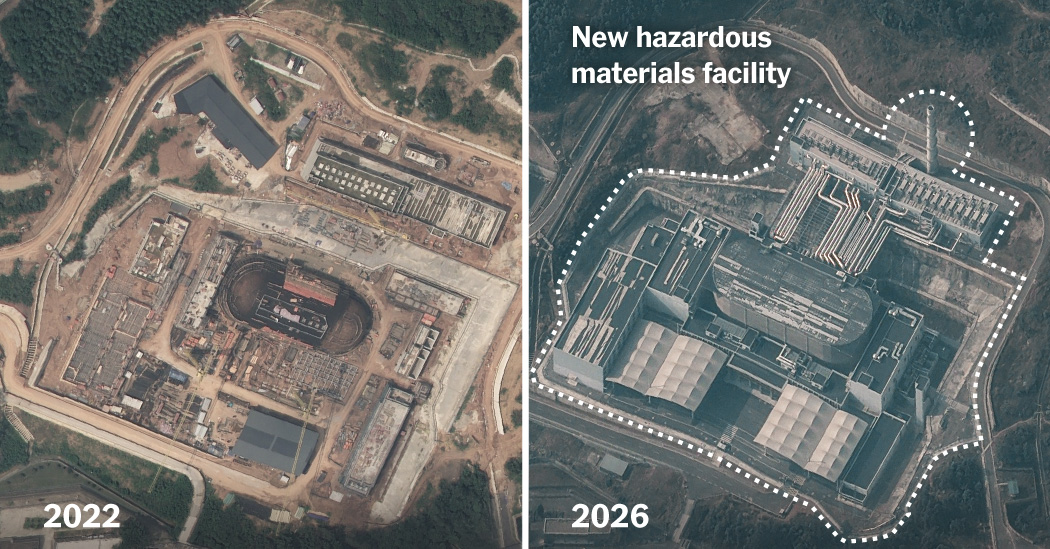
In the lush, misty valleys of southwest China, satellite imagery reveals the country’s accelerating nuclear buildup, a force designed for a new age of superpower rivalry.
One such valley is known as Zitong, in Sichuan Province, where engineers have been building new bunkers and ramparts. A new complex bristles with pipes, suggesting the facility handles highly hazardous materials.
Another valley is home to a double-fenced facility known as Pingtong, where experts believe China is making plutonium-packed cores of nuclear warheads. The main structure, dominated by a 360-foot-high ventilation stack, has been refurbished in recent years with new vents and heat dispersers. More construction is underway next to it.
Above the Pingtong facility entrance, a hallmark exhortation of China’s leader, Xi Jinping, appears in characters so large they are visible from space: “Stay true to the founding cause and always remember our mission.”
These are among several secretive nuclear-related sites in Sichuan Province that have expanded and undergone upgrades in recent years.
China’s buildup complicates efforts to revive global arms controls after the expiration of the final remaining nuclear arms treaty between the United States and Russia. Washington argues that any successor agreements must also bind China, but Beijing has shown no interest.
“The changes we see on the ground at these sites align with China’s broader goals of becoming a global superpower. Nuclear weapons are an integral part of that,” said Renny Babiarz, a geospatial intelligence expert who has analyzed satellite images and other visual evidence of the sites and shared his findings with The New York Times.
He likened each nuclear location across China to a piece of a mosaic that, seen as a whole, shows a pattern of rapid growth. “There’s been evolution at all of these sites, but broadly speaking, that change accelerated starting from 2019,” he said.
China’s nuclear expansion has been a growing source of tension with the United States. Thomas G. DiNanno, the State Department’s under secretary for arms control and international security, this month publicly accused China of secretly conducting “nuclear explosive tests” in contravention of a global moratorium. Beijing has rejected the claim as untrue, and experts have debated how strong the evidence is for Mr. DiNanno’s assertions.
China had more than 600 nuclear warheads by the end of 2024 and is on a track to have 1,000 by 2030, according to the Pentagon’s latest annual estimate. China’s stockpile is much smaller than the many thousands held by the United States and Russia, but its growth is still troublesome, said Matthew Sharp, a former State Department official who is now a senior fellow at the Center for Nuclear Security Policy at the Massachusetts Institute of Technology.
“I think without a real dialogue on these topics, which we lack, it’s really hard to say where it’s going, and that, for me, is dangerous,” he said, “because now we’re forced to react and plan around the worst-case interpretation of a concerning trend line.”
The sites in Sichuan were built six decades ago as part of Mao Zedong’s “Third Front,” a project to shield China’s nuclear weapons production labs and plants from strikes by the United States or the Soviet Union.
Tens of thousands of scientists, engineers and workers labored in secret to carve into the mountainous interior what Danny B. Stillman, an American nuclear scientist who visited the area, later called, in a coauthored book, “an inland nuclear empire.”
When China’s tensions with Washington and Moscow subsided in the 1980s, many “Third Front” nuclear facilities closed or shrank, and often their scientists moved to a new weapons lab in the nearby city of Mianyang. Sites like Pingtong and Zitong continued operating, but change in the years that followed was piecemeal, reflecting China’s policy then of keeping a relatively small nuclear arsenal, said Dr. Babiarz.
That era of restraint faded from about seven years ago. China began rapidly building or upgrading many nuclear weapons facilities, and construction at the sites in Sichuan also accelerated, Dr. Babiarz said. The buildup includes a vast laser ignition lab in Mianyang that could be used to study nuclear warheads without detonating actual weapons.
The design of the Pingtong complex suggests that it is being used to make the pits of nuclear warheads — the metal core, usually containing plutonium — according to Dr. Babiarz. He noted that its architecture was similar to that of pit making facilities in other countries, including the Los Alamos National Laboratory in the United States.
In Zitong, the new bunkers and ramparts are likely being used to test “high explosives,” experts say, referring to the chemical compounds that detonate to create the conditions for a chain reaction in nuclear materials.
“You have a layer of high explosives and the shock wave at the same time implodes into the center. This needs blast tests to perfect them,” said Hui Zhang, a physicist who researches China’s nuclear programs at the Kennedy School of Government of Harvard University, who examined Dr. Babiarz’s findings.
The complex includes an oval area about the size of 10 basketball courts.
The precise objective of these upgrades remains a subject of debate. Dr. Zhang said satellite imagery alone offers limited information. “We don’t know how many warheads have been produced, but we just see the plant expansion,” he said.
Some of the recent changes may simply reflect upgrades for safety, said Dr. Zhang, the author of a new book, The Untold Story of China’s Nuclear Weapon Development and Testing. Chinese nuclear engineers may also need more facilities and test areas at Zitong to modify warhead designs for new weapons, such as submarine-launched missiles, he said.
One major concern for Washington is how this larger, more modern arsenal might change China’s behavior in a crisis, particularly over Taiwan.
China wants to be “in the position where they believe they’re largely immune from nuclear coercion by the United States,” said Michael S. Chase, a former U.S. Deputy Assistant Secretary of Defense for China who is now a senior political scientist at RAND. “I think they probably judge that could come into play in a conventional conflict over Taiwan.”
Note: Research about the sites by Renny Babiarz’s company AllSource Analysis was funded by two organizations — the Open Nuclear Network and the Verification Research, Training and Information Center — which received support for the work from the Canadian government. The New York Times acquired its own additional satellite images of the sites and shared those images and Dr. Babiarz’s reports with other experts on nuclear weapons for their assessments.
Top image sources: Satellite images from Airbus, Sept. 9, 2022, and Feb. 5, 2026
